How to Play Tongits
Understand the game before you begin.
Artwork: SwertePlay illustration · Illustrative artwork. This guide covers general rules.
About Tongits
Tongits is a three-player rummy game from the Philippines, played with one 52-card deck. On each turn you draw, lay down sets and runs, and discard. You win a round by using up all your cards (Tongits), by calling a draw and having the lowest points, or by having the lowest points when the stock runs out.
- Players
- 3
- Deck
- 52 cards, no jokers
- Deal
- 12 cards each; the dealer gets 13
- Goal
- Empty your hand, or have the lowest points
Key features & rules
- Melds (bahay) are sets of three or four cards of the same rank, or runs of three or more cards in a row in one suit.
- Sapaw: you can add a card to any exposed meld, yours or an opponent’s, to lower your points.
- If you have not laid down a meld when the round ends, you are burned (sunog) and lose the round.
Tongits at a glance
| Card | Points |
|---|---|
| Ace | 1 |
| 2 to 10 | Face value |
| Jack, Queen, King | 10 each |
| How it ends | Who wins |
|---|---|
| Tongits: a player uses up every card | That player wins at once |
| Draw: a player with an exposed meld calls it | Lowest points wins; a tie goes to the challenger |
| The stock runs out | Lowest points among players with an exposed meld |
| Word | Meaning |
|---|---|
| Bahay (also buo) | A meld: a set or a run |
| Sapaw | Adding a card to an exposed meld |
| Sunog | Burned: no meld laid down when the round ends |
| Tongits | Going out by using every card |
| Draw | Ending the round early to compare points |
Step-by-step tutorial
Deal the cards
The dealer gives 12 cards to each player and takes 13. The rest go face down as the stock. The dealer starts by discarding one card.
Draw a card
On your turn, take the top card of the stock, or take the last discard if you can use it at once in a meld.
Lay down melds
Put any set or run face up on the table. You may keep a meld hidden in your hand, but you need at least one exposed meld to call or challenge a draw.
Sapaw (lay off)
Add cards to exposed melds: the fourth card of a set, or the next card of a run. Every card you lay off lowers your points.
Discard
End your turn by discarding one card face up. Play then passes to the next player.
End the round
The round ends when someone goes Tongits, someone calls a draw, or the stock runs out. Count the points left in each hand to find the winner.
A simple example
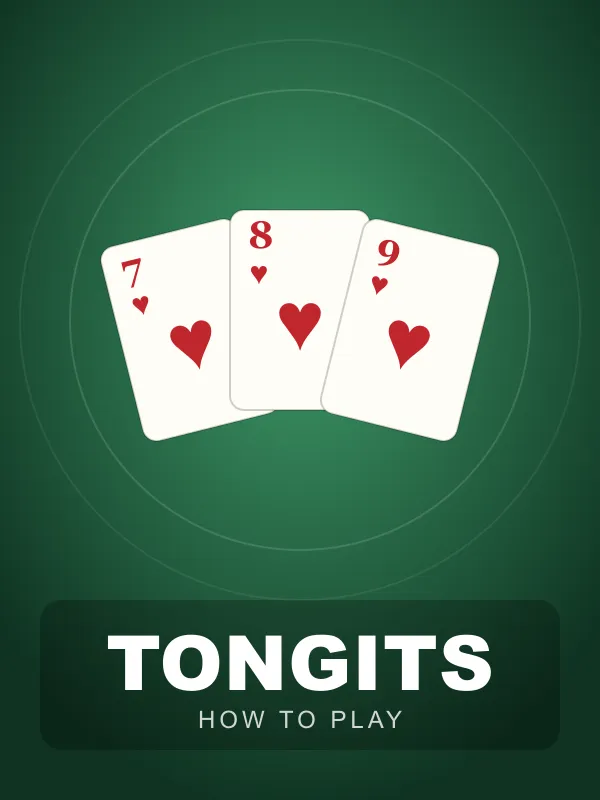
After laying down 7♥ 8♥ 9♥ and three Queens, you hold only 2♣ and 5♦, so your points are 2 + 5 = 7. You call a draw. If both opponents hold more than 7 points, you win. If an opponent challenges and also has 7, the challenger wins the tie.
An illustration of the rules, not a prediction of an actual result.
Common questions
What does sunog mean in Tongits?
Sunog means “burned”. You are burned if you have not laid down any meld when another player goes Tongits or calls a draw. A burned player cannot challenge and loses the round.
How many cards are dealt in Tongits?
Twelve cards to each player and thirteen to the dealer, from one 52-card deck with no jokers. The dealer plays first by discarding a card.
When can I call a draw in Tongits?
At the start of your turn, if you have at least one exposed meld. You cannot call a draw on the turn right after another player has laid off (sapaw) on one of your melds. Players with an exposed meld can then fold or challenge.
Is Tongits the same as Pusoy Dos?
No. Tongits is a rummy game: you build sets and runs and try to keep your points low. Pusoy Dos is a shedding game: you beat the last play with higher cards and try to empty your hand first.
Do house rules change Tongits?
Yes. Bets, jackpots and some tie rules differ between groups and apps. Agree on them before you start, or read the rules screen in the app you use.
Sources
Reviewed 10 November 2026. Rules and features can differ between versions. This guide is educational information and does not guarantee a win.